
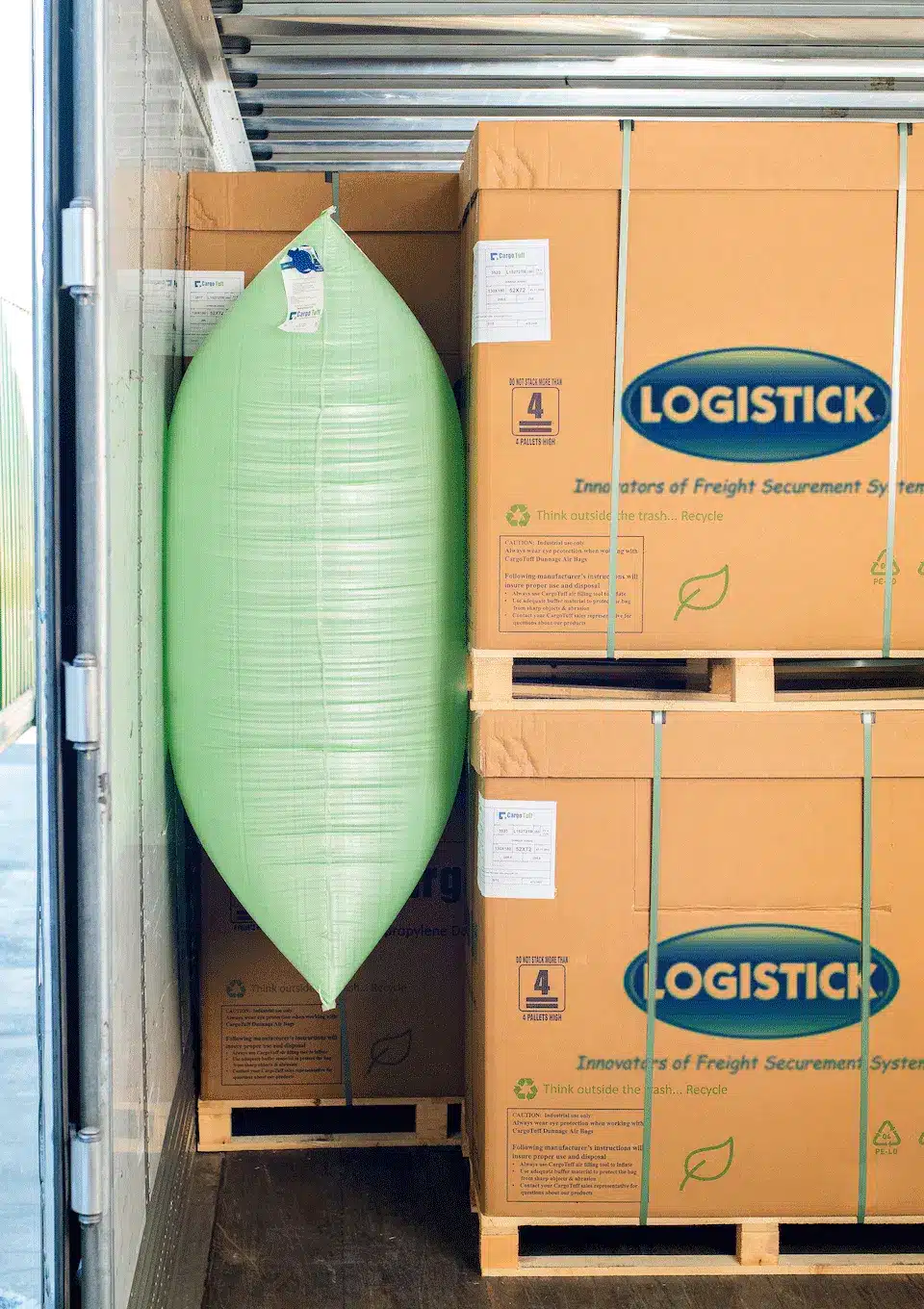
Dunnage air bags fill open space between freight, helping prevent pallets and other unit loads from shifting during transportation. Once positioned in a suitable void and inflated to the specified pressure, the bag creates outward force against the cargo on both sides. This helps stabilize the load and control lateral movement inside an enclosed trailer or ISO container. Join us as we take a look at how dunnage air bags work and how to pick the right one depending on the cargo and the container.
What Is a Dunnage Air Bag?
A dunnage air bag is an inflatable cargo securement device placed between loads or between freight and the interior wall of an enclosed trailer or container. Most shipping air bags include an airtight inner bladder surrounded by an outer layer designed to provide strength and resist damage.
Before inflation, the flat bag can be inserted into a void that would be difficult to fill with rigid material. As air enters the bag, it expands to contact the surfaces on each side. The inflated bag limits the room available for freight to move and helps distribute pressure over a broader area than a narrow point of contact would. Logistick supplies reusable polywoven Air Bags in various sizes and ratings to match different securement needs.
How Do Dunnage Air Bags Prevent Load Shift?
Freight that has room to move can build momentum during acceleration, braking, turning, vibration, rail coupling, or container handling. Once a pallet begins moving, the resulting force can damage packaging, collapse a load, or overload another part of the securement system.
An inflated dunnage bag closes the gap before that movement begins, applying pressure to the adjacent cargo and holding it in its planned position. This can help prevent costly cargo damage.
Though air bags are helpful in keeping cargo in its place, they should not be expected to repair weak packaging or support a load that cannot stand on its own. Pallets, cartons, crates, and wraps must be strong enough to tolerate the contact pressure and normal transportation forces.
How to Choose the Right Air Bag Size
Start by measuring the void at its narrowest practical point and identifying the available contact area on both sides. A bag must be large enough to fill the gap after inflation while maintaining sufficient surface contact with the cargo. Do not choose an air bag based only on its flat width and length. As a bag expands into a wider void, its usable face changes. A bag that appears large enough while flat may provide too little contact area after inflation. The correct selection also depends on the width of the void, container type, transportation method, and manufacturer-approved pressure ratings.
Where Should Dunnage Air Bags Be Placed?
Position the air bag where it can contact strong, stable surfaces on both sides of the void. The force should be distributed across the face of the freight rather than concentrated against one carton corner, unsupported panel, sharp projection, or damaged pallet.
Air bags are commonly placed between parallel rows of palletized freight, between a pallet row and the sidewall, or between cargo sections. Keep the bag away from nails, splinters, sharp pallet edges, exposed fasteners, and other surfaces that could puncture or abrade it. Protective material may be needed when the surrounding freight has rough edges.
Placement can also impact the unloading process. The valve should remain accessible, and employees should be able to release the air safely before removing the bag. Do not position a bag where its removal would expose workers to unstable or leaning freight.
How Are Dunnage Air Bags Inflated?
Install the uninflated bag in the selected void and connect an inflation tool that is compatible with its valve. Inflate the bag according to the manufacturer’s instructions until it fills the void and reaches the specified operating pressure.
Employees should never guess at inflation pressure. Underinflation may leave enough space for freight to move, while overinflation can damage the bag, packaging, or surrounding load. The correct pressure depends on the bag’s construction level and intended application.
Before closing the trailer or container, inspect the bag for proper placement, stable contact, leaks, damage, and a secure valve. The bag should remain within its rated application rather than being inflated until the load merely appears tight.
When Should You Use Air Bags Instead of Structural Bracing?
Air bags work well when the main problem is a defined void between stable cargo faces, particularly when controlling lateral movement. Their flexibility allows one product size to accommodate a range of gaps within its approved limits.
Structural blocking or bracing is more appropriate when the restraint must create a rigid barrier against significant longitudinal movement. A Loadbar or Wedge System performs a different job than an air bag. Wedges, for example, are intended for forward longitudinal restraint and should not be treated as a side-to-side securement device.
Many loads need a layered approach. A structural barrier may control front-to-rear movement while air bags fill lateral voids between pallet rows. Strapping may be added when irregular cargo needs stabilization at a particular height or location.
When Is a Rigid Void Filler a Better Choice?
Not every gap requires an inflatable product. Corrugated fillers, bulkhead fillers, side fillers, and adjustable products may be more practical when the void dimensions are predictable or when an operation does not want to manage inflation tools.
Void Gard® is an adjustable, reusable lateral void filler that expands from 8 to 16 inches. Void Gard XL expands from 16 to 32 inches. These products install without inflation equipment and are moisture stable, which can be useful in refrigerated enclosed trailers and other applications where moisture is a concern.
Unlike an air bag, an adjustable filler does not depend on a valve or maintained air pressure. However, it still must fit the void and be installed according to its instructions. The best option depends on the gap, load, equipment, operating environment, and transportation modes involved.
Inspect the Complete Load Before Dispatch
An air bag is only one part of the securement plan. Before an enclosed trailer or ISO container leaves, confirm that the weight is properly distributed, pallets are stable, packaging is intact, and every void has been addressed.
Check that each air bag is the correct size and rating, positioned against suitable surfaces, and inflated according to its instructions. Structural restraints should also be inspected for correct placement and installation.
Photograph the completed load before closing the doors. These records can help with employee training, quality reviews, and damage investigations. If the same void or load-shift problem appears repeatedly, revise the load plan rather than treating each shipment as a separate exception.
Select Air Bags for the Actual Load
The right dunnage air bag fills the intended void, provides adequate contact area, and carries a rating appropriate for the freight and complete route. Brand, dimensions, construction level, valve design, and inflation equipment all need to work together.
Logistick supplies multiple air bag brands and can review load photographs, cargo weights, void dimensions, equipment type, and transportation modes to help identify an appropriate option. Shippers can also compare inflatable bags, Void Gard, and other products on Logistick’s website.
0 Comments