
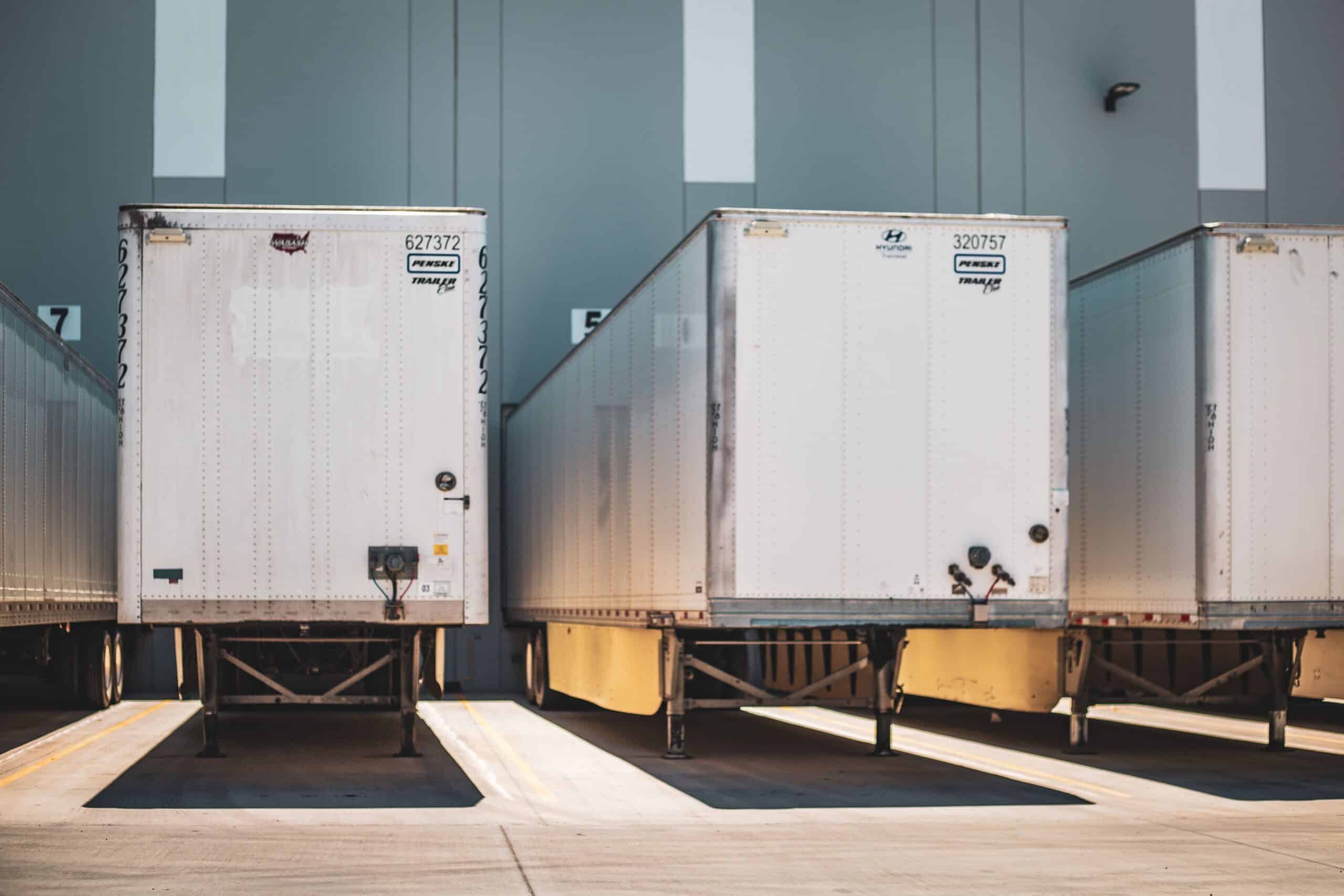
There is no single number of load bars that works for every enclosed trailer. Many loads need at least one Loadbar set installed horizontally against the rear face of the freight, while taller, heavier, unstable, or separated loads may require additional sets. The correct number depends on the freight’s weight, height, packaging, pallet configuration, void space, and position in the trailer. Trailer length alone does not determine the answer. Each Loadbar should be placed to prevent the cargo from moving, not at an arbitrary interval.
What Counts as One Loadbar Set?
A Logistick Loadbar system consists of two opposing pockets and a horizontal 2×4 spanning the interior width of an enclosed trailer. One pocket adheres to each sidewall, creating a barrier across the trailer.
Because the system spans from one sidewall to the other, the two pockets and the lumber should be counted as one complete Loadbar set. Ordering and inventory counts may list the individual plastic components, so confirm whether a case quantity is stated in pieces or complete sets.
Loadbars are typically installed horizontally, with the 2×4 parallel to the trailer floor. Both pockets should be positioned at the same height so the lumber sits level and makes proper contact with the freight.
Start With the Load Configuration
The goal is not to place as many Loadbars as possible. It is to create enough horizontal restraint at the correct locations to keep the freight from shifting during acceleration, braking, turning, vibration, and road shock.
Begin by looking at the complete load rather than the trailer alone. A fully loaded 53-foot trailer with tightly packed, uniform pallets may need a different arrangement than a shorter partial load with significant open floor space. The same is true for two shipments of equal weight when one consists of stable cartons and the other contains tall or irregular products.
Several factors determine how many Loadbar sets should be installed.
Load Weight
As freight becomes heavier, the force generated when it moves also increases. A single Loadbar set may be appropriate for some light- to medium-weight loads, but heavier cargo or a larger block of freight may require multiple restraint points or a different securement system.
Logistick Loadbar systems are designed primarily for light- to medium-weight applications. They should not be added repeatedly in an attempt to turn a system into one intended for a heavier load category. If the load exceeds the recommended application for the product, another blocking, bracing, strapping, or floor-mounted solution may be more appropriate.
Weight distribution matters too. A trailer carrying evenly distributed cartons does not behave exactly like one carrying a few dense pallets. Concentrated weight can place greater demand on a limited section of the securement system.
Freight Type and Pallet Stability
The way the commodity is packaged affects how much support it needs. Stable, consistently stacked pallets may be controlled with a Loadbar positioned against the rear of the final pallet row. Tall pallets, weak cartons, mixed-SKU loads, cylindrical products, and irregular freight may need restraint at more than one height or location.
A horizontal Loadbar should contact a structurally stable portion of the load. Placing it against fragile cartons or unsupported packaging can damage the product without controlling the pallet beneath it.
For tall or top-heavy freight, an additional horizontal Loadbar at another height may help control the upper portion of the load. Both bars must remain horizontal. Adding a second level is different from turning a Loadbar vertically, which is not a proper installation.
Trailer Length and Partial Loads
Trailer length influences how much open space can remain, but it does not create a standard formula such as one bar every several feet. What matters is where the freight ends and where separate sections of the load need to be restrained.
A partial load positioned toward the front of a long trailer can leave a large open area behind it. If the Loadbar is installed several feet away from the cargo, the freight may begin moving and build momentum before reaching the barrier. The Loadbar should instead be installed snugly against the freight so movement is controlled at its source.
Multiple sets may also be needed when different groups of freight must remain separated, such as stop-off shipments. In that situation, each independent section should be evaluated as its own securement zone.
Spacing Between Loadbars
Loadbar spacing should follow the freight configuration, not a universal distance measurement. The primary restraint should be placed directly against the rear face of the load. Avoid leaving a gap between the 2×4 and the cargo.
Additional sets may be appropriate when:
- Separate pallet groups need individual restraint
- Freight is loaded in distinct sections with voids between them
- Tall or unstable cargo needs support at more than one horizontal level
- The load configuration creates multiple potential movement points
- A securement review indicates that one set cannot adequately control the expected forces
More Loadbars are not a substitute for proper pallet placement, balanced weight distribution, strong packaging, and void management. Every part of the load plan must work together.
Choosing the Right Loadbar System
Logistick offers different Loadbar systems for different enclosed-trailer dimensions and operating needs.
The Loadbar Wide® is the newer-generation system developed for today’s standard-width trailers. It uses a standard 96-inch 2×4 and features an extra-deep lumber pocket. Its foam inserts create the necessary pressure across trailers with an inside width of approximately 99 to 102 inches, eliminating the need to cut the lumber in typical applications.
The Loadbar XL® is the original one-way Loadbar system. Despite the XL name, its main distinction is trailer fit rather than simply being a heavier-duty version of Loadbar Wide. Its larger adjustable foam insert helps accommodate variations in trailer width, including older trailers and refrigeration trailers. For maximum performance, the lumber is generally cut three inches shorter than the measured interior width at the installation point.
Measure the trailer at the exact installation area before selecting and preparing the system. Interior width can vary between trailers and even at different points within the same trailer.
How to Install Loadbars Correctly
Once the required number and locations have been identified, correct installation is essential.
First, select smooth sidewall areas that place the horizontal 2×4 level and directly against the freight. Clean and dry both application surfaces. Dust, dirt, condensation, frost, grease, or residue can interfere with adhesive performance, so use a dry cloth and, when needed, a scraper and rubbing alcohol.
Remove the tape backing from the first pocket and install it with the handle pointed away from the freight. Insert the prepared 2×4, place the second pocket on the opposite end, and slide it into position while its tape backing remains attached. Confirm that the lumber is horizontal, level, and snug against the cargo before exposing the second adhesive surface.
If the pressure is excessive, follow the applicable product instructions for adjusting the foam inserts. Never remove all the foam. Once installed, the pockets cannot be repositioned, so verify the height, orientation, and contact before pressing them firmly against the walls.
Follow the current installation and removal instructions for the specific Loadbar product being used. Removal guidance should also be available to the receiving facility so employees do not use unsafe methods or damage the trailer.
Get the Number Right Before Dispatch
The correct number of Loadbars is determined by the load, not by a universal trailer count. Start with a horizontal restraint directly against the freight, then evaluate whether the load’s height, weight, stability, spacing, or number of separate cargo zones calls for additional sets.
For unfamiliar commodities or recurring damage problems, a load review is the most reliable way to determine the right product, quantity, and placement. Logistick can evaluate load weights, photographs, trailer conditions, and shipping requirements to recommend an appropriate securement configuration.
Frequently Asked Questions
How many loadbars do you need per pallet row?
You do not automatically need one Loadbar for every pallet row. A Loadbar is commonly installed horizontally against the rear face of a group of tightly packed pallets. Additional sets may be needed for separate cargo sections, tall or unstable freight, open voids, or loads requiring restraint at more than one height. The final quantity should be based on the complete load configuration.
Can you use too many loadbars?
Yes. Adding unnecessary Loadbars can increase material and labor costs without correcting poor pallet placement, weak packaging, or excessive void space. More Loadbars also do not make a light- or medium-duty system suitable for cargo outside its intended application. Use the number required by the load plan and choose a different securement system when necessary.
Should loadbars be installed horizontally or vertically?
Loadbars must be installed horizontally, with the 2×4 parallel to the trailer floor. The pockets should be mounted at the same height on opposite walls so the lumber remains level. Never install a Loadbar vertically.
0 Comments