
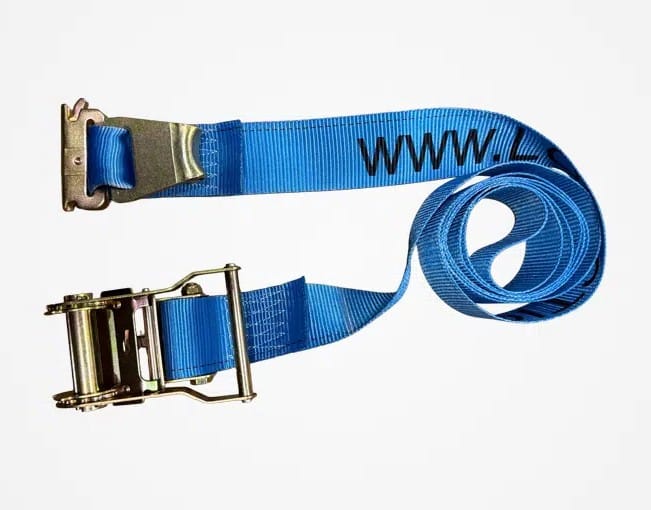
The right Strapping System depends on the freight, the anchor points inside the enclosed trailer, the amount of tension needed, and whether the restraint will be reused. E-track ratchet straps provide adjustable tension in trailers with installed E-track. Cam straps help unitize lighter cargo on pallets without applying as much force. LogiRatchet Strap® works with compatible anchors and eliminates disposable banding, while traditional banding and buckles remain practical for one-way shipments and approved intermodal configurations. Keep reading to find out how to pick the best strapping solution for your freight.
Start With the Freight and Trailer
Before selecting a strap, evaluate what needs to be restrained and where the available anchor points are located. A stable pallet of uniform cartons has different requirements than machinery, mixed freight, irregular products, or loose items that need to be unitized before loading.
Four questions can narrow the selection:
- Does the trailer already have compatible E-track?
- Does the freight need high, moderate, or limited tension?
- Is the restraint securing cargo to the trailer or bundling products to a pallet?
- Will the strap return to the shipping facility after delivery?
The complete securement plan must also account for cargo weight, packaging strength, movement direction, void space, and the condition of the trailer. A strap is one part of the system and should not be expected to correct poor weight distribution, damaged pallets, or large uncontrolled gaps.
E-Track Ratchet Straps for Adjustable Trailer Restraint
E-track ratchet straps attach to E-track rails mounted inside an enclosed trailer. Their E-track fittings lock into slots along the rail, allowing the strap to be positioned near the freight. The ratchet mechanism then applies and maintains tension.
Logistick offers 2-inch E-track ratchet straps in 12-foot, 16-foot, and 20-foot lengths, with a working load limit of 1,333 pounds. That rating applies to the strap assembly under its specified conditions. It does not mean that a single strap can secure any 1,333-pound load. Strap angle, anchor strength, cargo geometry, movement direction, and the number of restraints all affect the final configuration.
E-track ratchet straps are a strong option for regular use in company-controlled trailers that already have suitable rails. They can be adjusted for changing load dimensions and reused when they remain in acceptable condition.
Select the strap length based on the route it must follow around the cargo and between the chosen anchor points. A strap that is too short cannot be routed correctly, while an unnecessarily long strap creates excess webbing that must be secured out of the way. E-track orientation also affects where anchors are available and how the strap can be positioned.
Cam Straps for Pallet Unitization
Cam straps use a cam buckle rather than a ratcheting mechanism. They are generally easier to tighten by hand and apply less mechanical tension than a ratchet strap.
Logistick’s 1-inch Pallet Cam Straps are designed to secure loose cargo to pallets without hooks or shrink wrap. They are available in several lengths and are intended for use with the Pallet Cam Strap Tool Kit, which helps route the strap beneath the pallet.
This makes cam straps useful when the primary goal is keeping cartons or other products together as a unit before and during transportation inside an enclosed trailer. They can provide more control than relying on stretch wrap alone in a suitable application, while avoiding the higher tension of a ratchet mechanism.
Cam straps are not a direct substitute for E-track ratchet straps. A pallet cam strap stabilizes freight on the pallet, while an E-track strap connects cargo to trailer-mounted anchor rails. Some loads may need both unitization and trailer restraint.
Because cam straps apply less tension, they can also be considered for products or packaging that may be damaged by excessive compression. The strap should still be tight enough to control the load, and edge protection may be necessary where the webbing passes over vulnerable corners.
LogiRatchet Strap for Reusable Anchor-Based Securement
The LogiRatchet Strap® is a reusable alternative to traditional banding and buckles. Instead of connecting to standard E-track rails, the original LogiRatchet Strap hooks onto compatible Logistick strapping anchors such as Intermodal Strap®/XL, Super Strap®, and International Strap® 2.0.
A built-in tensioner allows employees to tighten the strap without a separate banding tool. The integrated magnet can temporarily hold the ratchet against a trailer or container wall during loading, keeping it accessible and off the floor.
At the destination, the user loosens the tensioner and releases the strap rather than cutting banding. This can reduce material waste and shorten removal time when the operation has a practical process for recovering the reusable strap.
LogiRatchet Strap is most attractive when a shipper wants the placement flexibility of Logistick’s anchor systems without using disposable banding on every load. However, reusability creates its own operational requirements. Straps must be recovered, returned, inspected, stored, and available for the next shipment.
For operations that need compatibility across different securement setups, the LogiRatchet Strap® DH adds both E-track and Logistick anchor clips. Product selection should be based on the anchor system actually installed in the enclosed trailer or container.
Banding and Buckles for One-Way Shipments
Polywoven banding creates a tensioned barrier when used with compatible Logistick anchors and properly matched buckles. This arrangement is common in one-way shipping because the banding travels with the freight and does not need to return.
Banding can be positioned around regular or irregular cargo and is available in different widths, materials, and strength ratings. The correct choice depends on the anchor product, cargo weight, transportation mode, and approved loading method.
Buckles are part of the system, not interchangeable accessories. Their size and design must match the banding and application. A wider or stronger band should not be paired with an unverified buckle simply because the material fits through it.
Banding is often a practical choice when the shipment is not expected to return and recovering reusable equipment would create more labor and expense than the material itself. The tradeoff is that employees must measure or prepare the banding, install the buckle, apply the correct tension, and cut the material during unloading.
Match Tension to the Cargo
More tension does not always mean better securement. Excessive force can crush cartons, deform products, damage palletized freight, or overload an anchor point. Too little tension allows the cargo to move and may cause the strap to loosen during transit.
Ratchet straps provide greater mechanical advantage and more precise tightening for loads that need firm restraint. Cam straps use hand-applied tension and are often better for pallet unitization or packaging that cannot tolerate strong compression. LogiRatchet Strap combines reusable webbing with a built-in tensioner, while banding systems use a buckle and, in many applications, a separate tensioning tool.
Whichever system is selected, straps should contact stable parts of the load. Use corner protection when webbing or banding could cut into packaging or when a sharp edge could damage the restraint.
Inspect Before Every Shipment
Reusable webbing should be inspected before each use. Remove a strap from service if it has cuts, significant abrasion, broken stitching, chemical damage, heat damage, deformed fittings, corrosion, or a ratchet or cam mechanism that does not work correctly.
E-track rails and other anchors also need inspection. A properly rated strap cannot perform as intended when attached to a damaged track or an unsuitable anchor.
For banding systems, confirm that the material and buckle match the product instructions and have not been damaged during storage. Employees should also know how to tension and remove the system safely.
Choose a System That Fits the Workflow
E-track ratchet straps are often the right choice for adjustable, reusable restraint in enclosed trailers with compatible E-track. Cam straps help keep lighter products unitized on pallets. LogiRatchet Strap provides a reusable option for compatible Logistick anchor systems, while banding and buckles support one-way shipments and route-specific securement methods.
Logistick’s full Strapping Systems line includes these products and the components needed to complete each setup. If several options appear suitable, the Logistick team can review the freight, trailer, anchor points, and shipping route to help identify a system worth testing.
0 Comments